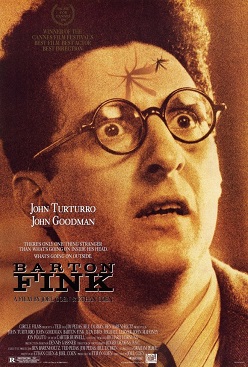
Barton Fink (1991)
A playwright who has just had a hit about the common man is hired by a studio to write a wrestling picture. He checks into a hotel where the wallpaper is coming off the walls in the heat, sits down at the typewriter, and nothing comes. Next door there is a very friendly insurance salesman. The pick for the week of October 9, 2026.
- Director
- Joel Coen and Ethan Coen
- Year
- 1991
- Runtime
- 1h 56m
- Country
- United States
- Rated
- R
- Genre
- Drama, Thriller
Chat aired
Friday, October 9 at 7:30 PM PT
This conversation has already happened. Catch the current week’s pick on the homepage.
See this week’s pick →Why we picked it.
The Coens wrote this in three weeks while they were completely stuck on Miller's Crossing, which is the most useful fact about it. It is a film about writer's block made by two people escaping their own. Barton sits in front of a typewriter for most of the running time producing one paragraph, and the movie around him gets steadily stranger, hotter and more threatening, until the hotel corridor is on fire and nobody can tell you exactly what is literal.
The joke underneath it is savage. Barton talks constantly about wanting to write for the common man, about the poetry of ordinary people, about theatre that belongs to the working man. He lives next door to an actual working man who repeatedly tries to tell him a story, and Barton talks over him every single time. He wants the common man as a subject and has no interest in him as a person. Everything that happens to him follows from that.
It is also very funny in a way that surprises people who have only heard it is difficult. Michael Lerner's studio boss is a magnificent comic creation, all hugging and shouting and instant reversals. The Coens know Hollywood absurdity cold. What makes the film unsettle you is that the comedy never stops, even when the picture has clearly turned into something else.
What to watch for. No spoilers.
The hotel is a character.
The wallpaper peels, the pipes moan, the glue sweats, and the corridor gets longer. Roger Deakins shoots his first Coen film here and the room is doing the work an explanation would do in another movie. Watch how the state of the walls tracks the state of Barton's head.
Charlie trying to tell his story.
Count the number of times John Goodman says he could tell you some stories and Barton changes the subject. It happens again and again. The whole film is contained in that one repeated moment.
The picture above the desk.
A woman on a beach, one hand shading her eyes. Barton stares at it the entire movie. Where it turns up at the end is the closest the Coens come to telling you what any of this meant.
A closer read.
The film is not interested in giving you a solution and people should know that going in. The box, the hotel, the fire, the ending, none of it resolves into a single reading. The Coens made a puzzle that is genuinely about the feeling of not being able to think, and a clean answer would break it. Bring your interpretation to the chat rather than looking one up.
W.P. Mayhew, the drunk southern novelist, is a barely disguised Faulkner, who really did write for the studios and really did drink through it. Notice that his assistant Audrey is doing the actual writing. The film keeps showing you men with reputations and the invisible people producing the work.
There is a reading of the film as being about the late 1930s and early 1940s more broadly, about intellectuals who claimed to speak for ordinary people while catastrophe built up around them. The hotel is called the Earle, the year is 1941, and Charlie's rampage has language attached to it that is hard to miss. It is one reading and the film supports several.
The thing that lands hardest is smaller than any of that. Barton finally writes something, and it is good, and nobody will ever read it, and the studio owns it and will not make it. He got what he wanted at the exact moment it stopped being worth anything.
This is the most divisive pick in the run and it is here for that reason. Some people find it a masterpiece and some find it a shaggy dog story with good production design, and both camps have a case. Watch it and bring what you think the box means, because there is no consensus to fall back on. It is the rare film where the ten minutes afterwards are genuinely better than watching it alone.
If you like Barton Fink, you will probably like:
Discussion seeds.
You do not have to use these. Most chats find their own ground. But if Friday starts slow, try one.
- Barton says he writes for the common man and cannot listen to the one living next door for thirty seconds. Have you seen that gap between what someone says they care about and how they behave.
- The film refuses to explain the box, the fire or the ending. Did that frustrate you, or is a film allowed to leave it open.
- Charlie says he tried to tell Barton and Barton never listened. Who was the last person who tried to tell you something while you were busy talking.
Aired October 9, 2026
See this week’s pick.
Go to homepage →