Close Encounters of the Third Kind (1977)
Steven Spielberg's Close Encounters of the Third Kind is the great American film about looking up. Richard Dreyfuss is Roy Neary, a power lineman who sees something over Indiana one night and is left with an obsession he cannot name, the shape of a mountain he has never visited. It is a film of wonder and yearning, and also of the quiet damage that wonder can do to an ordinary family. Watch it slow this week and let it work on you. The pick for the week of August 21, 2026.
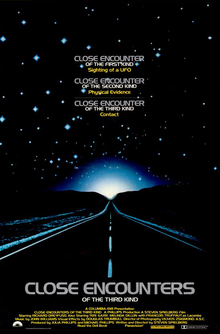
- Director
- Steven Spielberg
- Year
- 1977
- Runtime
- 2h 15m
- Country
- United States
- Rated
- PG
- Genre
- Sci-Fi Drama
Chat aired
Friday, August 21 at 7:30 PM PT
This conversation has already happened. Catch the current week’s pick on the homepage.
See this week’s pick →Why we picked it.
Close Encounters of the Third Kind is Spielberg's film about ordinary people touched by something vast, and about the price of not being able to let it go. Roy Neary, played by Richard Dreyfuss, is an Indiana power lineman with a wife and kids and a normal, cluttered life. Then one night on a dark country road his truck is bathed in light from above, and he is left changed, carrying a vision he can neither explain nor escape, the shape of a flat topped mountain he keeps building out of shaving cream, dirt, and mashed potatoes.
This is the luminous week, the hopeful counterweight after the dark and ambiguous Total Recall. Where that film asked whether any of it was real, this one answers that something real is out there, and it is trying to reach us. The two make a strange, beautiful sci-fi diptych, one about doubting the world and one about trusting the sky. Spielberg builds his wonder patiently, out of children's toys that come alive, a five note musical phrase that becomes a language, and Vilmos Zsigmond's light pouring through every window like a promise.
Under the awe there is a real cost, and Spielberg does not hide it. Roy's obsession pulls his family apart, frightens his wife, and isolates him even as it lifts him toward contact. It is a film about yearning so complete that it burns the ordinary life right out of a man. Made in 1977 by a director who had just terrified the world with Jaws, Close Encounters turned the same craft toward hope, and it remains the purest expression of Spielberg's lifelong subject, the human face turned upward, lit by something it cannot yet understand.
What to watch for. No spoilers.
The light.
Vilmos Zsigmond shot this, and the film is built from beams pouring through doorways, windows, and dashboard vents. Watch how Spielberg uses light as a character, warm and frightening at once. Long before the mothership arrives, the movie has taught you to feel awe simply from the way a room fills with glow. That is the whole grammar of Spielberg's wonder being invented in front of you.
The five notes.
John Williams wrote a five note phrase that is not a theme so much as a handshake, a way for two species to say hello without words. Watch for how it starts as an eerie signal and slowly becomes a conversation. It is one of the great ideas in movie music, a melody that carries the entire meaning of the film, that contact might be as simple and as human as a shared song.
Roy's obsession.
Watch Dreyfuss build the mountain out of anything he can find, at the dinner table, in the living room, tearing his home apart. Spielberg lets it be funny and then heartbreaking. The mashed potato scene is the hinge of the film, the moment wonder curdles into something that scares his family. Notice that the movie never quite decides whether Roy is blessed or lost, and that ambiguity is the cost it is honest about.
A closer read.
Spielberg wrote this himself, chasing a feeling he had carried since childhood, the wish that the lights in the sky were friendly. He cast François Truffaut, the French New Wave master, as the scientist Lacombe, and that gentle, watchful presence gives the film its soul, a man who approaches the unknown with curiosity instead of fear. The choice tells you everything about the movie's spirit, that it wants to greet the universe, not fight it. Vilmos Zsigmond's photography and John Williams' score do the rest.
Notice that Spielberg refuses the easy scares. There are no monsters here, no invasion, no weapons that matter. The tension comes instead from not knowing, from a government hiding the truth and a man risking everything to reach it. The camera keeps finding faces tilted up toward light, mouths open in awe, and it makes you sit inside that wonder rather than rush past it. It slows you down by insisting that astonishment is worth your patience.
It is also, at its heart, a film about the loneliness of seeing what no one else believes. Roy loses his family to a vision he cannot share, and the ending lifts him toward the thing he wanted at the cost of everything he had. That mix of triumph and loss is why it belongs on a slow watch. See it alone, with your full attention, and then carry it to one other person, because it is a film that wants to be talked about, not just marveled at.
Watch it once for the pure wonder, the ships, the light, the five note song rising into a chorus. Watch it again and it plays as something quieter and sadder, the story of a man who followed a vision straight out of his own life. It does not want only your amazement. It wants you to feel what the amazement cost. Give it the full two hours and fifteen minutes without distraction, then find one person and talk about whether Roy was blessed or ruined. That is the honest way to meet a film that looks this far up.
If you like Close Encounters of the Third Kind, you will probably like:
Discussion seeds.
You do not have to use these. Most chats find their own ground. But if Friday starts slow, try one.
- Roy loses his family to a vision he cannot explain to them. By the end, did you read him as blessed, chosen, or simply lost.
- The five note phrase turns contact into a shared song rather than a battle. What did it do to you that the film imagines meeting the unknown with music instead of weapons.
- Last week's Total Recall asked whether any of it was real. This one says something real is out there. Which vision of the unknown felt truer to you, and why.
Aired August 21, 2026
See this week’s pick.
Go to homepage →