No Way Out (1987)
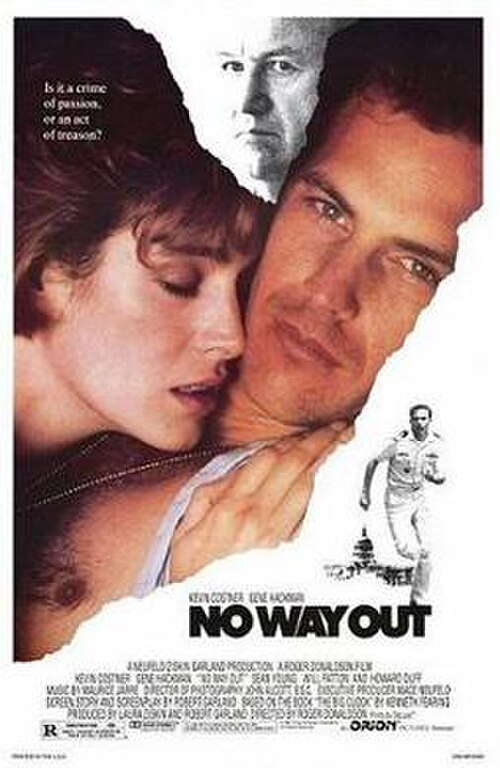
Roger Donaldson's No Way Out drops a Navy officer into the middle of a Pentagon cover-up, then puts him in charge of finding the killer the cover-up is hiding. The catch is that the killer they are describing is him. Kevin Costner running out of time while a computer slowly develops a photograph that will end him. The pick for the week of July 3, 2026.
- Director
- Roger Donaldson
- Year
- 1987
- Runtime
- 1h 54m
- Country
- United States
- Rated
- R
- Genre
- Thriller, Crime, Drama
Chat aired
Friday, July 3 at 7:30 PM PT
This conversation has already happened. Catch the current week’s pick on the homepage.
See this week’s pick →Why we picked it.
No Way Out is a thriller built like a trap closing one click at a time. Tom Farrell is a Navy officer pulled into the orbit of the Secretary of Defense, and into a love affair he should have walked away from. When a death has to be covered up, the men in charge invent a phantom culprit and assign Farrell to hunt him down. He says yes before he understands that the description fits no one but himself. From that moment the movie is one long held breath.
Roger Donaldson runs the whole thing on a clock you can feel. Deep in the Pentagon basement, a Polaroid pulled from the scene is being computer-enhanced one fuzzy line at a time, and when it finishes it will show Farrell's face. So you watch a man try to steer an investigation toward dead ends while the one piece of evidence that damns him slowly sharpens into focus. The tension is not who did it. It is how long he can keep standing in the room where the answer is being developed.
Gene Hackman plays the Secretary as a weak, frightened powerful man, and Will Patton plays the aide who will do anything to protect him, which makes him the most dangerous person in the building. Heat asked what you would risk for the work. Serpico asked what honesty costs inside a crooked system. No Way Out asks something colder. What do you do when the machine you serve decides you are the thing it needs to destroy.
What to watch for. No spoilers.
The clock is a photograph.
Most thrillers use a bomb or a deadline. This one uses a blurry Polaroid being enhanced pixel by pixel in a back room. Watch how Donaldson keeps cutting back to that screen. Every time it gets a little clearer, the walls move in a little more.
Costner before he was a star.
This is Kevin Costner the year before The Untouchables made him famous, playing a man whose easy charm is the only thing keeping him alive. Watch the sweat under the smile. The whole performance is a person improvising one more lie while the floor disappears under him.
The last five minutes.
No Way Out has one of the great endings of the 1980s, the kind that makes you rethink the entire film the second it lands. We will not say a word about it. Just watch closely, and do not look anything up before the chat.
A closer read.
The bones of this story are older than they look. No Way Out is adapted from The Big Clock, a 1946 noir novel by Kenneth Fearing, first filmed in 1948. The setup is the same nightmare in both. A man is put in charge of a manhunt for himself and has to sabotage his own investigation in plain sight. The 1987 version moves it into the Pentagon, which turns a clever thriller into a story about power and paranoia at the top of the country.
What makes the dread work is that nobody is a cartoon villain. The Secretary is not evil, he is scared, and that is worse. The aide who escalates everything believes he is being loyal. Each step of the cover-up is a reasonable-seeming choice by a frightened man, and the choices stack into something monstrous. The film keeps showing you that catastrophe does not need a mastermind, only ordinary people protecting themselves.
Sean Young's Susan is the human cost the men keep stepping over. Watch her early scenes for the version of Farrell's life that could have existed, the one outside the corridors and the cover stories. By the time the manhunt is running, the movie remembers her even when the powerful men have moved on, and that memory is what gives the suspense its weight. It is not only a man trying to survive. It is a man trying to survive what was done to someone he loved.
Knowing it is a trap from the first act does not loosen the grip, it tightens it. You are not waiting to learn whether Farrell is in danger. You are watching exactly how the danger arrives, one enhanced line of a photograph at a time, and counting the exits as they close. The pleasure of this movie is dread you can measure.
Watch it once for the white-knuckle chase through the Pentagon and the ending that pulls the rug out. Watch it again and it is colder and sadder, a film about how easily a system will spend the people inside it. Most of us have felt the smaller version, the moment you realize the institution you trusted is quietly deciding you are expendable. No Way Out is that feeling at full volume, with a clock running down and nowhere left to stand.
If you like No Way Out, you will probably like:
Discussion seeds.
You do not have to use these. Most chats find their own ground. But if Friday starts slow, try one.
- Farrell says yes to running the manhunt before he understands the trap. Have you ever agreed to something fast, to look willing, and then realized too late what you had walked into.
- Nobody in the cover-up thinks of themselves as the villain. Each one is just protecting someone or something. Where do you think the real damage actually comes from in this story.
- The whole film is a clock counting down a developing photograph. Did knowing the evidence would eventually point at Farrell make it more tense or less, and why.
Aired July 3, 2026
See this week’s pick.
Go to homepage →