Platoon (1986)
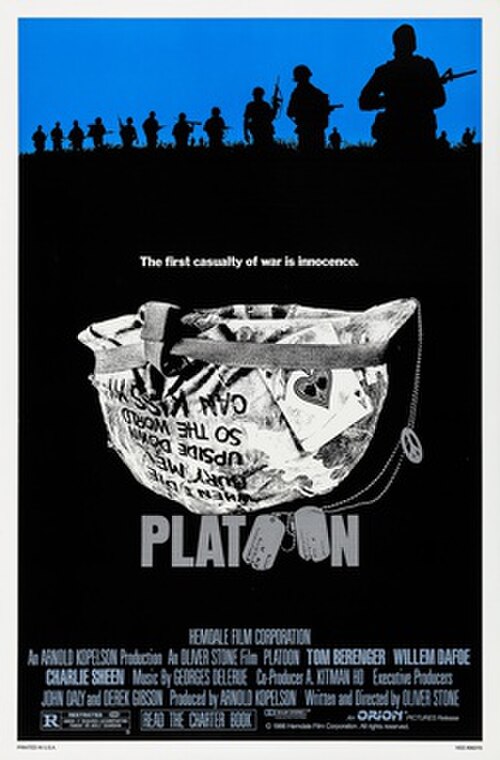
Oliver Stone's Platoon is the war film made by a man who was actually in the war, and it shows in the mud, the fear, and the refusal to make any of it look like glory. Charlie Sheen is the new arrival caught between two sergeants, Tom Berenger and Willem Dafoe, who fight for his soul as much as for the hill. It is a hard, honest, ground level movie, and it slows you down the way only real testimony can. The pick for the week of August 7, 2026.
- Director
- Oliver Stone
- Year
- 1986
- Runtime
- 2h 0m
- Country
- United States
- Rated
- R
- Genre
- War Drama
Chat aired
Friday, August 7 at 7:30 PM PT
This conversation has already happened. Catch the current week’s pick on the homepage.
See this week’s pick →Why we picked it.
Platoon is a war film with no distance in it, because the man who made it was there. Chris Taylor, played by Charlie Sheen, is a college kid who volunteers for Vietnam and lands in a unit that is exhausted, frightened, and coming apart. Oliver Stone based him on himself, and the film has the texture of memory rather than spectacle, the boredom, the leeches, the terror that arrives out of nothing and then leaves the survivors to keep walking.
This is the hard week, and it earns the weight after a run of hope and cleverness. The story hangs on two sergeants who stand for two ways of surviving. Barnes, played by Tom Berenger, is scarred and ruthless and certain. Elias, played by Willem Dafoe, is just as tough but has kept something human alive. The film is really about which of them a young man decides to become. Chris says near the end that they were fighting for possession of his soul, and he means it.
Under the combat is one plain, devastating idea, that the worst enemy was never across the tree line. Stone shows a war that rots its own men from the inside, in a village scene as unbearable as anything in American film, and he refuses to let anyone off the hook, including his stand in. Made in 1986 by a veteran who carried it for years, Platoon won Best Picture by telling the truth others had dressed up. It is testimony, not entertainment, and it asks to be watched that way.
What to watch for. No spoilers.
Barnes and Elias.
The two sergeants are the whole film in miniature, two fathers offering a young man two different souls. Watch the scenes where Chris looks from one to the other. Stone is not staging a good guy and a bad guy. He is staging a choice about who you become when everything decent is under pressure.
The Elias shot.
You likely know the image even if you have not seen the film, a man on his knees with his arms flung up, set to Samuel Barber's Adagio for Strings. Watch how the whole movie bends around that moment. It is where Platoon stops being about a war and becomes about what a war does to the men who are supposedly on the same side.
The texture.
Stone was an infantryman, and the small true details are the point, the wet, the ants, the way fear has downtime. Watch the ordinary stretches as closely as the firefights. The film's honesty lives in the boredom and the exhaustion, not just the noise. That is the part most war movies leave out.
A closer read.
Oliver Stone wrote Platoon years before anyone would make it, then finally shot it after Salvador proved he could. He served a full tour in Vietnam and was decorated, and he put the cast through a punishing boot camp so the fatigue on screen would be real. The authenticity is not a style, it is a debt he was paying. Robert Richardson shot it, and Barber's Adagio gives the grief a shape.
Notice that the film refuses the usual comforts. There is no clean mission, no clear victory, no easy villain across the field. The camera stays down at grunt level, in the dirt with the youngest and most frightened men, and it makes you sit in their uncertainty. In a genre that loves to make war look like purpose, Platoon insists on confusion, which is closer to the truth. It slows you down by refusing to look away.
It is also, at its center, one young man trying to hold onto himself, narrated in letters home like someone talking himself back to sanity. That lonely, first person register is the reason it belongs on a slow watch. See it alone, with your attention fully on it, and then carry it to one other person, because it is a film that needs to be talked about, not shaken off.
Watch it once for the story of a boy who goes to war and comes back changed. Watch it again and it plays as a confession, one veteran's attempt to make you feel what he cannot put down. It does not want your excitement. It wants your attention. Give it the full two hours without distraction, then find one person and talk about what it cost. That is the only honest way to meet a film like this.
If you like Platoon, you will probably like:
Discussion seeds.
You do not have to use these. Most chats find their own ground. But if Friday starts slow, try one.
- Chris says Barnes and Elias were fighting for possession of his soul. Which one do you think he ended up carrying, and which would you have.
- Stone was actually there, and the film is full of downtime, fear, and mud. Did that first person texture change how the war felt compared with other war movies.
- The narration says the real enemy was inside them, not across the field. What did you take that to mean by the end.
Aired August 7, 2026
See this week’s pick.
Go to homepage →