The Long Goodbye (1973)
A private detective drives his friend to the Mexican border in the middle of the night and asks no questions. By morning the friend is accused of murder and the police want to know what Marlowe knew. He spends the rest of the movie being the only person in Los Angeles who still thinks a favor means something. The pick for the week of September 4, 2026.
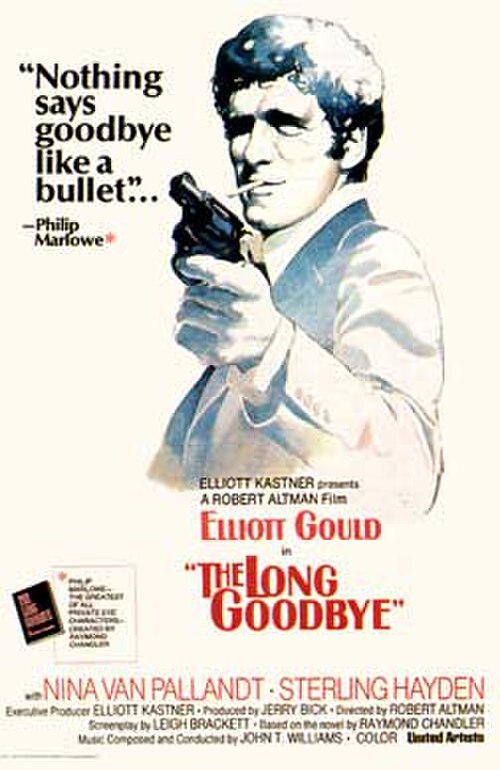
- Director
- Robert Altman
- Year
- 1973
- Runtime
- 1h 52m
- Country
- United States
- Rated
- R
- Genre
- Crime, Mystery
Chat aired
Friday, September 4 at 7:30 PM PT
This conversation has already happened. Catch the current week’s pick on the homepage.
See this week’s pick →Why we picked it.
Raymond Chandler's Philip Marlowe was a man with a code in a city that had none, and that was the whole appeal. Altman keeps the code and moves the city forward twenty years, and the joke is that nobody notices Marlowe is there. Elliott Gould plays him rumpled and chain smoking and permanently three seconds behind the conversation, wandering through a Los Angeles of health food, yoga on the balcony next door, and people who would not understand the word loyalty if you wrote it down for them.
The plot is a Chandler plot and it barely matters. A friend needs a ride to Tijuana. A rich alcoholic writer has gone missing. A gangster wants money that Marlowe does not have. What matters is the drift, the way Altman lets scenes run past their point and lets everyone talk over each other, so that you are always half hearing the important thing. It is a detective story shot like a documentary about a man losing his footing.
And then there is the ending, which changed what a Marlowe movie could be and made a lot of people angry in 1973. Altman spends two hours establishing that Marlowe will forgive anything, and then shows you the one thing he will not. It is the most abrupt final thirty seconds in a decade full of them. Whether it is a betrayal of Chandler or the most honest thing anyone ever did with him is the argument, and it is a good one to have with somebody.
What to watch for. No spoilers.
The cat, for ten minutes.
The film opens with Marlowe trying to feed his cat the right brand and failing, and it goes on far longer than it should. That is Altman telling you what kind of movie this is. Nothing will be urgent, everything will be observed, and small loyalties matter more than large ones.
The camera never sits still.
Vilmos Zsigmond keeps it slowly drifting and zooming in almost every shot, so you are never quite settled. Watch how often it wanders off the person speaking. The film is always looking slightly past the plot at the world around it.
The theme song, over and over.
John Williams wrote one tune and Altman uses it as the score, the radio, a doorbell and a bar piano. Once you notice it you cannot stop. It is funny, and it is also a joke about a man who keeps hearing the same thing and cannot take the hint.
A closer read.
Gould's Marlowe mutters the same three words all movie long, it's OK with me, and it is the key to the character. He says it about everything, and it is not calm, it is a man who has decided not to fight the current. He lets the police push him around, lets the neighbours ignore him, lets a gangster threaten him in his own kitchen. The phrase is a shrug he has made into a philosophy.
The Los Angeles here is genuinely strange. Marlowe's neighbours are young women doing candlelit yoga on their balcony who barely register him. The gangster Marty Augustine is casually, shockingly violent in a way that has nothing to do with movie tough guys. Sterling Hayden's writer is a Hemingway figure who has outlived his own myth. Everyone is performing a version of themselves and nobody is doing it well.
Altman called Gould's Marlowe Rip Van Marlowe, a man who fell asleep in 1953 and woke up in 1973 without changing his suit. That is the joke of the wardrobe, the car, the smoking, all of it. But the movie is careful. It never makes him ridiculous. He is the only person in it with a fixed point, and the film respects that even while it shows him how little it buys.
The mystery, when it resolves, is almost beside the point, which is why some people bounce off the movie entirely. The question Altman is actually asking is quieter. What happens to a man whose whole identity is being loyal when the people he is loyal to were never worth it. The last scene is his answer, and it arrives without a word of explanation.
Watch it once and it can feel shapeless, a shaggy movie about a man wandering around Los Angeles. Watch it again knowing where it ends and every drifting scene tightens up, because you can see what he is refusing to notice. It is a film about the cost of being the last person still playing by rules everyone else abandoned. Then he walks down the road playing a harmonica, and you can decide for yourself whether that is a victory.
If you like The Long Goodbye, you will probably like:
Discussion seeds.
You do not have to use these. Most chats find their own ground. But if Friday starts slow, try one.
- Marlowe says it's OK with me about almost everything that happens to him. Is that a man at peace, or a man who has given up, and did your read on it change by the end.
- The last thirty seconds are a hard break from the Marlowe of the books. Did the ending feel earned to you, or like Altman pulling the rug out.
- Everyone around Marlowe has moved on to a new way of living and he has not. Have you ever been the person still keeping a promise nobody else remembered making.
Aired September 4, 2026
See this week’s pick.
Go to homepage →